

Early Medieval Garnet Art: A Comparative Analysis of Anglo-Saxon, Sasanian, and Byzantine Jewelry Traditions


By Mitra FakhrMovahedi
Editor-in-Chief, Gold & Jewellery Magazine
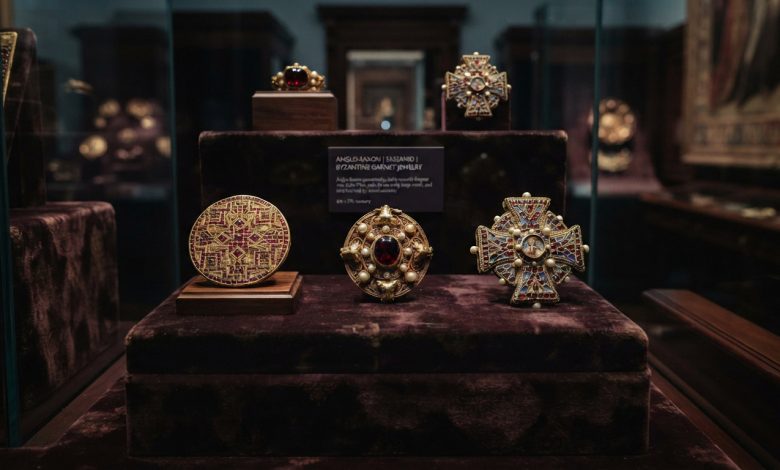
In the historiography of early medieval lapidary craftsmanship, the execution of garnet-inlaid metalwork among the Anglo-Saxons cannot be evaluated as an isolated artistic phenomenon. Instead, it emerged within a transcontinental ecosystem where three distinct geopolitical spheres—the Germanic North of Western Europe, the Sasanian Empire of Eranshahr, and the Byzantine Mediterranean—were dynamically intertwined through long-distance maritime trade routes, diplomatic gift exchanges, military movements, and artisan migration. A comparative examination of these three jeweler traditions illuminates how fundamentally divergent theological, political, and material worldviews governed the application of identical raw materials: gold, copper alloys, and gem-quality red garnets.
       [ South Asian & Central European Mines ]
        (Garibpet, Rajasthan, Sri Lanka, Bohemia)
                          │
          ┌───────────────┼───────────────┐
          ▼               ▼               ▼
   [ Sasanian Eranshahr ]  [ Byzantine Empire ]  [ Anglo-Saxon Kingdoms ]
    • Regal Power         • Divine Light        • Dynamic Kinetic Light
    • Bold Cabochons      • Filigree/Niello     • Micro-Cloisonné
    • Solitary Gems       • Liturgical Inlay    • Waffle Foils (Paillons)
Technical and Material Foundations: Sourcing, Trade Networks, and Structural Principles
From the fifth through the seventh centuries CE—an era often termed the “Garnet Millennium” in gemological literature—extensive trade routes connected South Asia and Central Europe with Western European and Middle Eastern workshops. Archaeometric analyses (notably LA-ICP-MS and proton-induced X-ray emission) reveal that the garnets utilized across these regions were not local substitutes but predominantly high-grade almandine and pyrope-rich garnets originating from the Garibpet deposit in Telangana (India), Sri Lanka, and, to a lesser extent, the Bohemian Massif in Central Europe.
These raw gemstones traversed the Maritime Silk Road through Sasanian ports in the Persian Gulf and Red Sea corridors, entering Byzantine markets or passing northward through Frankish middlemen into Anglo-Saxon Britain. Despite sharing access to these global supply chains, each culture adapted the raw material through distinct goldsmithing techniques:
- Cellular Frameworks (Cloisonné vs. Cast Bezels): Setting gemstones within constructed metal cells or soldered wire partitions versus heavy individual rim mountings.
- Geometric Symmetry: Organizing field compositions around rigid central or bilateral axes to express cosmic or imperial order.
- Chromatic Contrast: Pairing red stones with polished gold, niello, or enamel to create visual hierarchy and symbolic depth.
1. The Sasanian Tradition: Dynastic Splendor and Cosmological Order
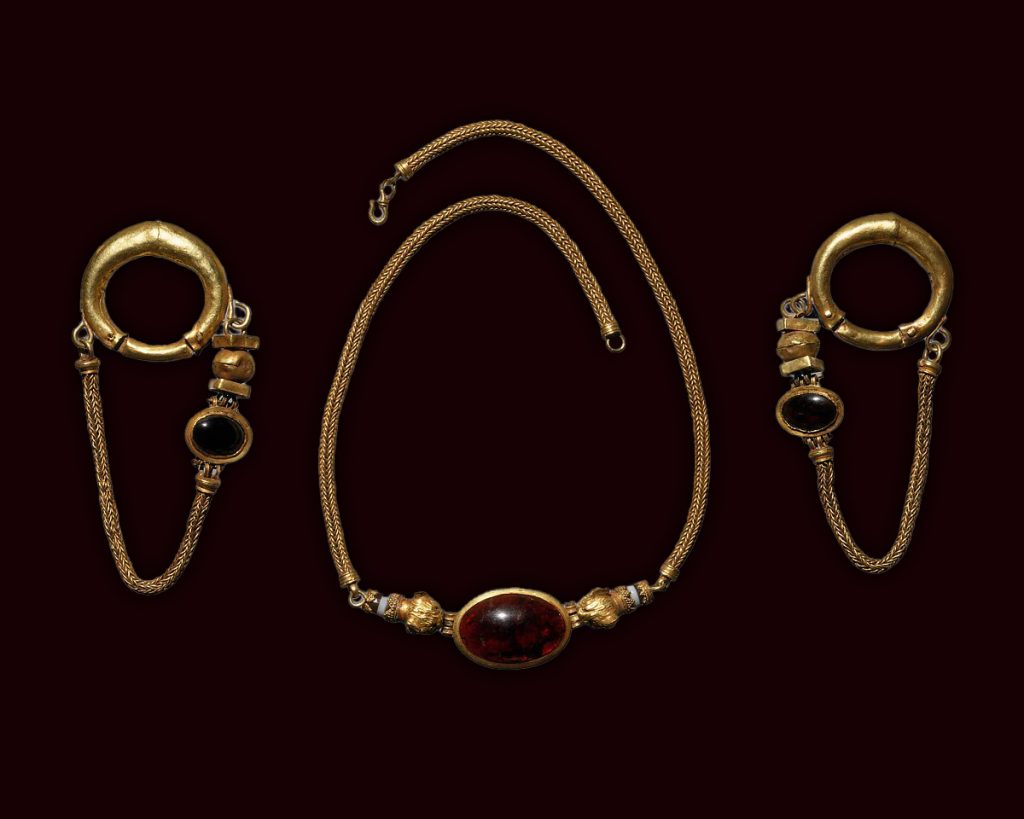
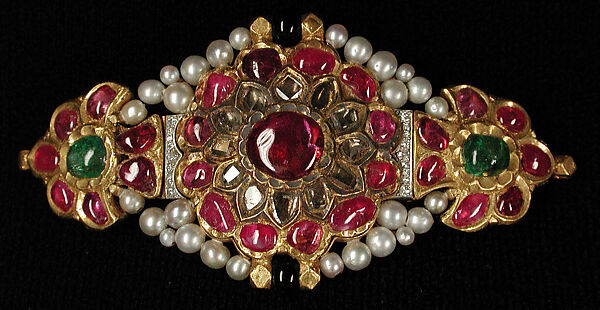
Within Sasanian Iran (224–651 CE), jewelry functioned as an extension of royal iconography (farrah or divine glory) and state hierarchy. Sasanian metalwork prioritized substantial mass, structural solidity, and clear visual readability from a distance.
┌────────────────────────────────────────────────────────┐
│                   SASANIAN BEZEL SETTING               │
│                                                        │
│                  ╭───────────────╮  <-- High-Dome      │
│                 ╱                 ╲     Almandine      │
│                │   Garnet Gem      │    Cabochon       │
│                 ╲                 ╱                    │
│             ┌────┴────────────────┴────┐               │
│             │   Thick Repoussé Bezel   │               │
│             └──────────────────────────┘               │
└────────────────────────────────────────────────────────┘
Key Characteristics:
- Primacy of the Individual Gem: Rather than segmenting stones into thin slices, Sasanian lapidaries preferred large, high-dome cabochons or convex oval cuts that showcased the depth and natural weight of the stone.
- Heavy Architectural Frames: Gems were set into thick, repoussé or cast gold rims, often bordered by heavy granulation or repoussé pearls representing royal diadems.
- Centralized Symmetry: Designs centered on clear focal points, avoiding dense cellular grid patterns.
- Symbolic Motifs: Inlays and engravings depicted imperial emblems, such as pairidaeza (floral scrolls), the wings of Verethragna, solar disks, and royal investiture symbols.
In the Sasanian paradigm, light served to accentuate the stone’s physical mass and inherent luxury. The stone was treated as a solid, permanent repository of wealth and authority, mirroring the divine order of the King of Kings (Shahanshah).
2. The Byzantine Tradition: Lumen Christianum and Sacred Transcendence
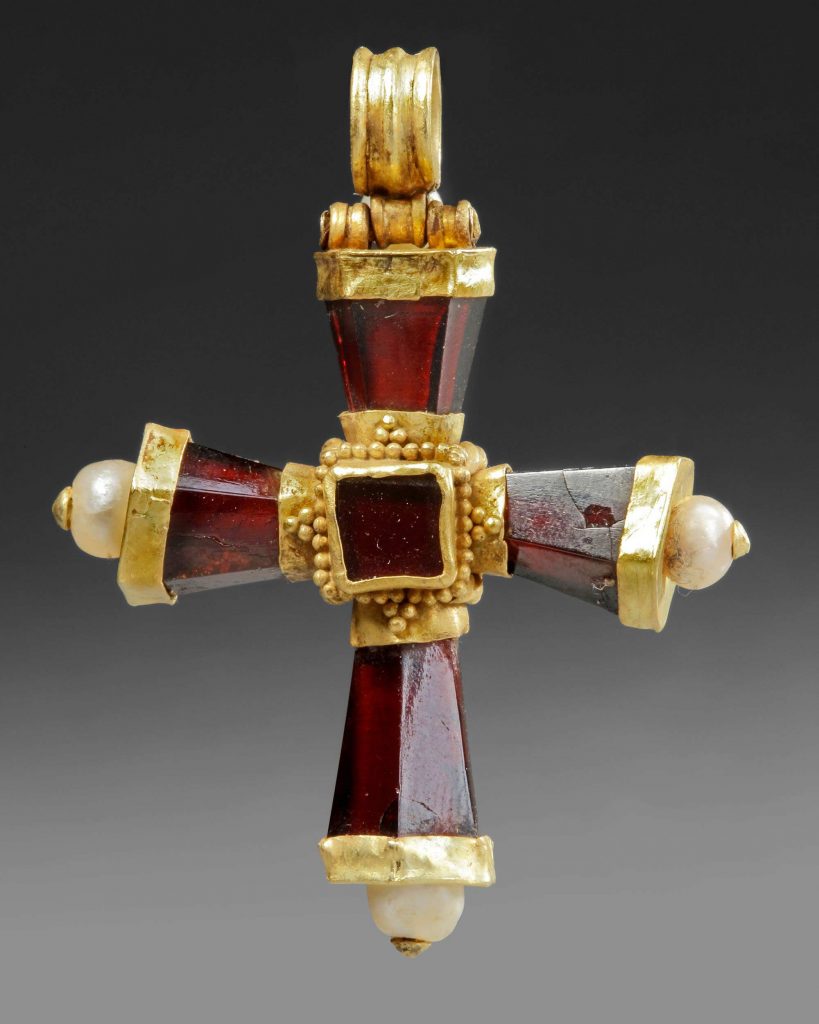
In the Byzantine Empire, lapidary arts were subordinated to Christian theology. Jewelry design transitioned from Greco-Roman classical forms into a visual medium designed to evoke lux divina—the uncreated light of God.
┌────────────────────────────────────────────────────────┐
│               BYZANTINE HYBRID SETTING                 │
│                                                        │
│            [ Openwork Gold / Opus Interrasile ]        │
│          ╭───────────────────────────────────╮         │
│          │ Enamel │ Thin Garnet │ Open Gold  │         │
│          ╰───────────────────────────────────╯         │
│            [ Pearl Borders & Monogram Inlays ]         │
└────────────────────────────────────────────────────────┘
Key Characteristics:
- Polychromatic Integration: Garnets were rarely used in isolation; goldsmiths set them alongside emeralds, pearls, sapphire, and opaque vitreous enamels (champlevé and early cloisonné).
- Radiant Gold Surfaces: Extensive use of opus interrasile (openwork gold leaf puncture) allowed light to pass through the metal structure itself, surrounding red garnets with an airy, shimmering framework.
- Theological Iconography: Designs prominently featured the crux gemmata (jeweled cross), christograms, step-crosses (such as the Golgotha cross depicted on late sixth-century intaglios), and ecclesiastical monograms.
- Dematerialization of Metal: Thin stone slabs and back-carved intaglios reduced the apparent weight of the gold, giving the object an incandescent, self-illuminating quality.
Light in Byzantine jewelry was speculative and mystical. The gemstone was not merely a symbol of martial or political dominance, but an earthly allegory for the heavenly Jerusalem.
3. The Anglo-Saxon Tradition: Kinetic Geometry and Interlace Mechanics
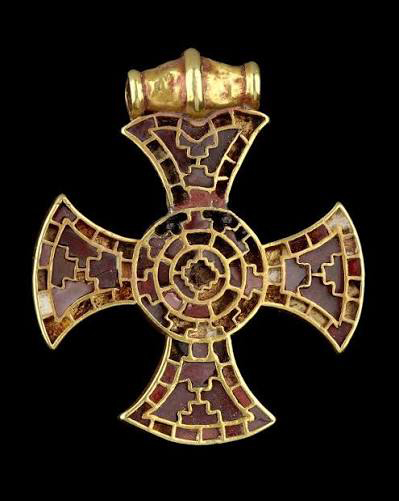
In stark contrast to Sasanian mass and Byzantine openwork, seventh-century Anglo-Saxon workshops—exemplified by masterworks from the Sutton Hoo ship burial and the Staffordshire Hoard—developed an advanced form of micro-matrix garnet cloisonné.
┌────────────────────────────────────────────────────────┐
│               ANGLO-SAXON MICRO-CLOISONNÉ              │
│                                                        │
│             | Garnet Tile (0.5–1.0 mm thick) |         │
│             ├────────────────────────────────┤         │
│             | Waffle-Patterned Gold Foil     |         │
│             ├────────────────────────────────┤         │
│             | Composition Paste / Cement     |         │
│             └────────────────────────────────┘         │
│            └─ Gold Cell Wall (Cloison Wire) ─┘         │
└────────────────────────────────────────────────────────┘
Key Characteristics:
- Micro-Slicing and Cold Inlay: Anglo-Saxon lapidaries ground raw garnets into ultra-thin wafers (often between 0.5 and 1.0 mm thick). These flat tiles were cut with geometric precision to fit into complex cell walls (cloisons) made of soldered gold strips.
- Patterned Foil Backings (Paillons): Underneath every semi-transparent garnet tile, goldsmiths placed a hatched or waffle-patterned gold foil. This foil acted as a reflector, bouncing incoming light back through the red stone and creating a shimmering, flame-like radiance.
- Zoomorphic Interlace and Abstraction: Stone layouts followed complex Germanic Style II animal art, where lapidary tiles formed interlocking boars, eagles, serpents, and geometric grids.
- Kinetic Functionality: Items were designed specifically for body movement—shoulder clasps, belt buckles, and sword pommels. As the wearer moved, changing angles of incident light caused the underlying foil patterns to flash sequentially across the cellular grid.
Comparative Synthesis
A cross-cultural comparison highlights how these three early medieval civilizations transformed identical trade materials into distinct visual languages:
| Feature / Dimension | Sasanian Tradition | Byzantine Tradition | Anglo-Saxon Tradition |
|---|---|---|---|
| Primary Lapidary Cut | High-dome convex cabochons & large carved intaglios | Cabochons, flat-cut slabs, & engraved intaglios | Ultra-thin geometric tiles (0.5–1 mm) |
| Metalworking Technique | Heavy repoussé, thick cast bezels, & granulation | Opus interrasile, fine wire filigree, & enamel inlay | Cold-cut micro-cloisonné & soldered foil cells |
| Optic & Light Logic | Static absorption; highlights material density | Mystical refraction; evokes divine transcendence | Kinetic reflection; flashes through patterned gold foils |
| Predominant Motifs | Imperial diadems, floral scrolls, & solar symbols | Step-crosses, monograms, & liturgical symbols | Step-geometry, cell grids, & zoomorphic interlace |
| Socio-Cultural Function | Representation of royal power (farrah) | Ecclesiastical display & sacred protection | Martial identity, oath-bonding, & warrior prestige |
Conclusion
The comparative analysis of early medieval garnet craftsmanship demonstrates that techniques and styles were far more than aesthetic preferences—they were material manifestations of distinct civilizational worldviews.
While Sasanian artisans used garnet to express dynastic authority through physical mass, and Byzantine masters channeled the material into liturgical expressions of divine light, Anglo-Saxon metalsmiths synthesized imported raw gems and Mediterranean techniques into an original Germanic art form. By converting dense red stones into dynamic networks of kinetic light, Anglo-Saxon jewelers achieved an independent artistic synthesis that remains one of the high points of early medieval European craftsmanship.