
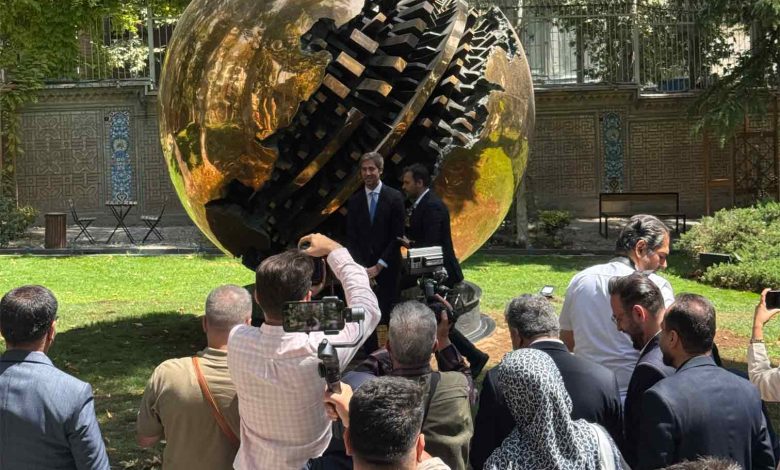
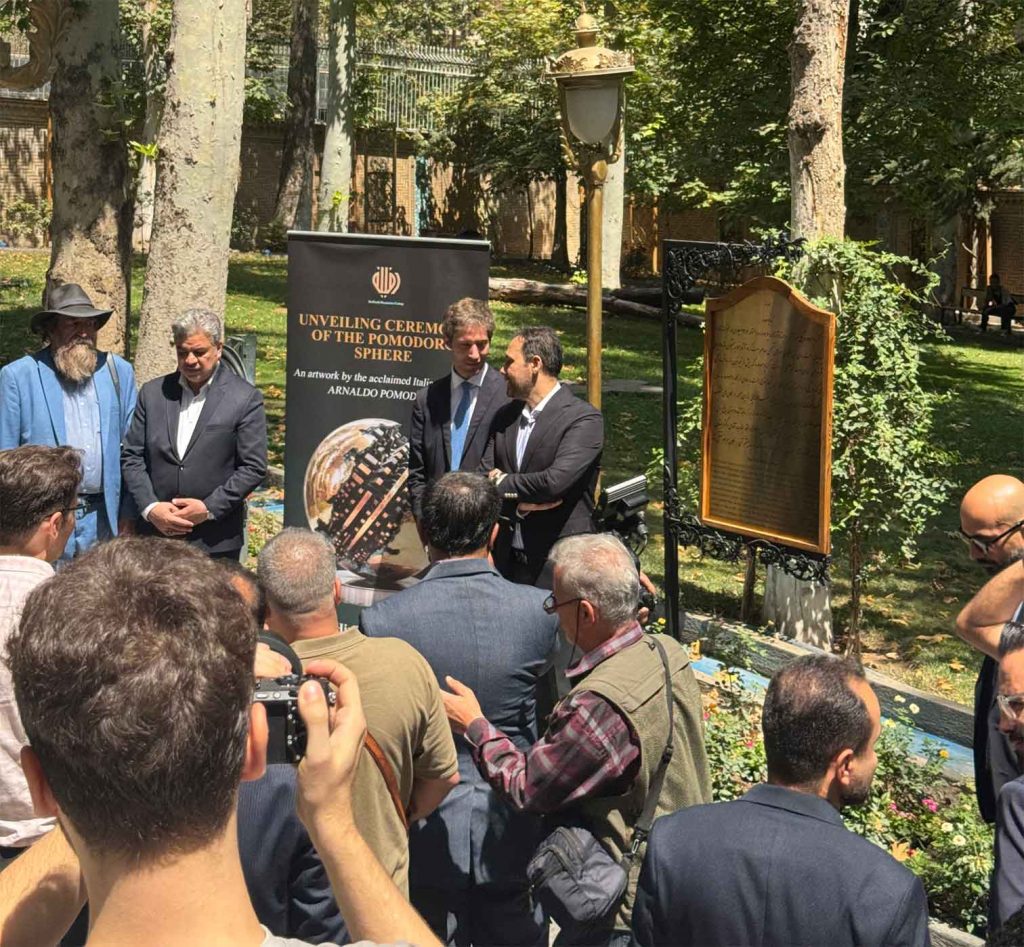
The unveiling ceremony of “Pomodoro’s Sphere,” a monumental work by renowned Italian artist Arnaldo Pomodoro, was held today, Sunday, September 1, at Tehran’s Time Museum, marking the centenary of the artist’s birth. Following years away from a museum setting and a four-month conservation process, the landmark bronze sculpture has once again been placed on public display.
Today, the Time Museum in Tehran hosted an event that went far beyond the unveiling of a single artwork. It became an occasion to reflect on contemporary art, the preservation of artistic heritage, and the enduring cultural ties between Iran and Italy.
“Pomodoro’s Sphere,” a monumental bronze sculpture that had stood for years at Eram Park in Tehran, has now found a new home in a museum following a four-month conservation and restoration process.
The ceremony was attended by Hamidreza Soleimani, CEO of the Museums of the Mostazafin Foundation; Ahmad Mohit Tabatabaei, President of the Iranian Museums Association; Amir Ghasemi, Head of the Tehran Tourism Headquarters; the Cultural Attaché of Italy in Iran; representatives of Iran’s Ministry of Cultural Heritage, Tourism and Handicrafts; and a number of museum professionals and figures from the cultural and artistic community.
The presence of the Italian Cultural Attaché added another important dimension to the event. Pomodoro is not only one of the most influential figures in contemporary Italian art; his work has also become part of Iran’s own cultural and artistic landscape. The presence of such an artwork in Tehran illustrates how art can transcend geographical boundaries and become part of an ongoing cultural dialogue between Iran and Italy.
A Three-Ton Sculpture with a Remarkable History
Born in 1926, Arnaldo Pomodoro began his artistic career in Milan, where much of his practice and research focused on space, form, and the relationship between volume and its surrounding environment. His visual language extends beyond conventional ideas of sculptural beauty, exploring the tension between exterior surfaces and inner worlds, order and disruption, structure and fragmentation.
“Pomodoro’s Sphere” is a striking example of this approach. At first glance, the monumental bronze sphere appears to be a simple geometric form. Yet as viewers move closer, the fractured and intricately articulated surface reveals another world within it.
The sculpture was purchased and brought to Tehran in the 1970s. For many years, it was displayed at Eram Park, where prolonged exposure to environmental conditions left the work vulnerable to various forms of damage. Weighing approximately three tons, the bronze sculpture is regarded, from a museum perspective, as a significant example of contemporary international art.
The international standing of Pomodoro’s work can also be seen in the presence of his sculptures in prominent institutions and locations, including the United Nations Headquarters, Trinity College, and the Vatican Museums.
Four Months to Bring a Masterpiece Back to Life
One of the most significant aspects of the project was the conservation and restoration of the sculpture. According to Mitra Etezadi, a conservator of historical artworks, the restoration process lasted four months and was carried out at one of the museums affiliated with the Mostazafin Foundation.
The conservation of a sculpture of this scale involves far more than simply cleaning or treating its bronze surface. Its enormous dimensions and weight, the conditions in which it had previously been kept, and the damage accumulated over decades presented the conservation team with a complex set of technical challenges.
Speaking on the sidelines of the ceremony, Etezadi discussed the difficulties involved in the project, from assembling an experienced conservation team to addressing the physical challenges presented by the sculpture itself.
But conservation was only one part of the story.
Moving a Three-Ton Giant Through Tehran
Another remarkable aspect of the project was the challenge of transporting “Pomodoro’s Sphere” to the Time Museum.
Moving a sculpture of this size and weight through Tehran required careful planning, specialized equipment, and close coordination. The height of the sculpture created additional complications, particularly when navigating the city’s bridges and other height restrictions along the route.
The operation required the use of a crane and detailed planning to ensure that the sculpture could be transported safely to its new location.
What visitors see today as a monumental artwork quietly standing inside a museum is, in fact, the result of months of technical, conservation, engineering, and logistical work.
Pomodoro: An Artist Who Lives On Through His Work
For the team at Gold & Jewellery Magazine, attending the ceremony was more than simply an opportunity to see a major sculpture.
Standing before a work whose creator was born a century ago, and witnessing its return to public view in Tehran, inevitably raises a larger question: How does an artist create something capable of outliving its own maker by generations?
Arnaldo Pomodoro was born in 1926. Yet in the centenary year of his birth, one of his most significant works is once again being unveiled and celebrated in Tehran.
Perhaps this is one of the most enduring definitions of art: the artist eventually leaves us, but the world created through their work continues to speak.
“Pomodoro’s Sphere” is more than a bronze object. Every incision, fracture, plane, and interruption across its surface contributes to the artist’s visual language. The seemingly perfect geometry of the sphere is disrupted, revealing a complex interior world beneath its ordered exterior.
The work seems to challenge the very idea of a complete and closed form. What appears solid and stable from a distance becomes fragmented and dynamic up close.
Between Past, Present, and Future
Dr. Ahmad Mohit Tabatabaei, who was also present at the ceremony, spoke about the importance of preserving and presenting such works within Iran’s museum landscape. He highlighted the significant efforts made by the Mostazafin Foundation over the past four decades in supporting the preservation and presentation of artworks, as well as the continuity of its museum-related activities and its contribution to keeping art accessible and alive for new generations.
He also referred to the presence of works by major international artists in Iran, noting Pomodoro alongside artists such as Alberto Giacometti whose works in Iran represent an important part of the country’s broader contemporary art heritage.
From this perspective, Pomodoro’s Sphere can also be understood as a work situated between past and future: an object that carries the memory of an earlier moment while simultaneously suggesting movement, transition, and the possibility of what lies ahead.
That interpretation seems particularly fitting for the work itself. The sphere, traditionally associated with wholeness, the world, and movement, is transformed by Pomodoro into a fractured and open structure. Its interior becomes visible, and the apparent order of the exterior gives way to a language of rupture, movement, and transformation.
When Art Crosses Borders
The unveiling of “Pomodoro’s Sphere” in Tehran is also, in its own way, a cultural moment shared between Iran and Italy.
The sculpture was created within the artistic context of Italy, yet for decades it has formed part of the cultural history of contemporary art in Iran. The presence of the Italian Cultural Attaché alongside museum officials, cultural representatives, conservators, and members of the artistic community reinforced this dimension of the event.
Art can be one of the most enduring forms of dialogue between nations.
An artwork may begin its journey in Milan, travel to Tehran, spend decades in a public space, endure the effects of time and environment, undergo conservation, and eventually find a new life inside a museum—without losing the identity and artistic language of its creator.
In that sense, “Pomodoro’s Sphere” has become more than an Italian sculpture in Tehran. It has become part of a shared cultural narrative between two countries whose artistic and cultural connections continue to evolve.
A Commemorative Stamp for a Centenary
The ceremony also included the unveiling of a commemorative stamp dedicated to Arnaldo Pomodoro, marking the artist’s centenary and symbolically recording his legacy and the presence of his work in Iran.
Today, “Pomodoro’s Sphere” is no longer simply a sculpture belonging to a collection. After years in a public park, exposure to damage, conservation, and a challenging relocation, it has been given a renewed opportunity to be seen, studied, and experienced in a museum environment.
Perhaps this is the true meaning of an enduring work of art: time does not erase it; instead, each generation discovers something new within it.
For us at Gold & Jewellery Magazine, being present at the unveiling and meeting the conservators, museum professionals, cultural figures, and people whose lives are devoted to art was a reminder that preserving art is never simply about protecting an object.
It is about preserving a piece of cultural memory—and ensuring that future generations can continue their own conversation with the past.
“Pomodoro’s Sphere” has been given a new life in Tehran, precisely in the centenary year of its creator’s birth.