
Historical Trajectory of Varsho in Iran and the Mandaean Enameling Masters

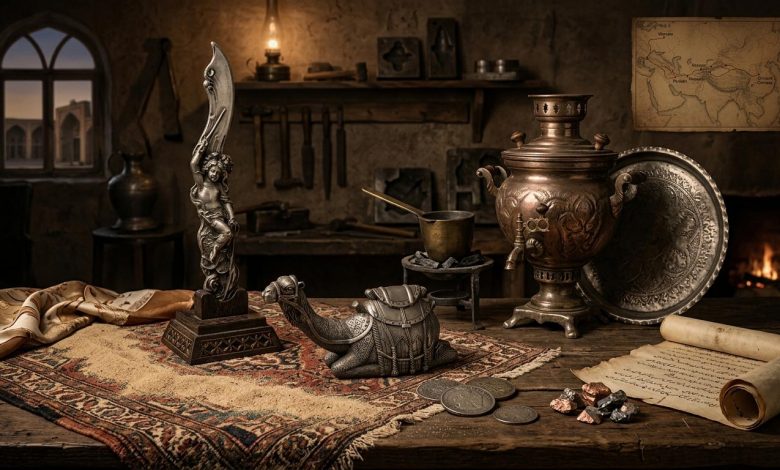
By Bahram Zahroni
Jewelry Designer, Metalsmith, Engraver, and Enameling Instructor
Abstract & Chemical Composition of Nickel Silver (Varsho)
Nickel silver—traditionally known in Iran as Varsho—is a non-ferrous copper-based alloy typically composed of approximately 60% copper ($\text{Cu}$), 20% nickel ($\text{Ni}$), and 20% zinc ($\text{Zn}$). Within metallurgy and jewelry manufacturing, the ratio of copper to nickel governs the alloy’s physical aesthetics and mechanical characteristics. Higher nickel concentrations yield a bright white lustre closely approximating fine silver ($999\text{ Ag}$) or sterling silver ($925\text{ Ag}$), whereas higher copper proportions impart a yellowish cast akin to brass alloys.
Despite its commercial trade name “German Silver” or “German Nickel Silver,” the alloy contains no elemental silver.
Global Origins and the Evolution of Varsho Silversmithing in Iran
The alloy’s origins trace back over 2,000 years to ancient China, where natural ores of copper and nickel were smelted into paktong (“white copper”). Zinc was subsequently introduced to optimize ductility, tensile strength, and corrosion resistance. Introduced to European markets via Indian trade routes, this copper-nickel-zinc system gained widespread adoption as German Silver. By 1900, it largely superseded copper as the primary substrate for electroplated silver (EPNS).
In Iran, nickel silver working emerged during the Safavid era and reached its zenith under the Qajar and Pahlavi dynasties. Raw sheet metal imported from Germany and Poland (Warsaw) led Iranian artisans to coin the term Varsho after the Polish capital.
During the premiership of Amir Kabir, master metalsmiths in Isfahan, Borujerd, and Dezful adapted Russian metalwork techniques to manufacture samovars, serving trays, and decorative hollowware. By integrating traditional chasing (qalam-zani) and repoussé with contemporary motifs, Iranian artisans established a distinct silversmithing heritage.
Industrial Decline & Modern Status
The introduction of stainless steel in the mid-20th century severely impacted traditional nickel silver production. In response, artisans focused on high-end, intricately engraved objects—such as ewers, incense burners, mirrors, and candlesticks. However, import restrictions on sheet alloy further contracted the trade. Modern production is primarily centered in Borujerd (officially designated as Iran’s National City of Varsho in 2019) and Dezful, where small-scale workshops largely rely on remelting vintage hollowware to preserve the craft.
Material Properties and Applications in Jewelry & Decorative Arts
Due to its favorable mechanical properties and aesthetic resemblance to silver, nickel silver found extensive application across multiple industries:
- Jewelry & Personal Adornment: High malleability and workability under hot-stamping and die-striking made Varsho an economical alternative to sterling silver. Excellent corrosion resistance prevented oxidation staining during soldering and fabrication. Historically, Native American artisans crafted bangles, pectorals, belt buckles, and equestrian accoutrements from the alloy. Recent attempts to revive Varsho-based fashion jewelry in Turkey and Afghanistan have met with limited commercial traction.
- Acoustic & Musical Instruments: Preferred material for brasswind and woodwind componentry, including flutes, French horns, and clarinets, due to its acoustic resonance and durability.
- Industrial & Technical Uses: High thermal and electrical conductivity make it useful in specialized electrical contacts, laboratory apparatus, and aerospace components. Its copper content also provides innate antimicrobial properties useful in architectural hardware and food-service items.
The Mandaean Enamelists and the Role of Varsho in Bench Apprenticeship
In traditional Iranian society, Varsho served as an accessible silver substitute for household goods and bridal dowries (e.g., galash tea-holders, trays, and regional jewelry like cholab hijab pins, bangles, armbands, and stone-set khoseh bangles).
                                  ┌── Bench Practice substrate for apprentices
Mandaean Master Metalsmiths ──────┼── Economical alternative to Sterling Silver
                                  └── Base for Chasing (Qalam-zani) & Fabrication
The Mandaean community—followers of Saint John the Baptist with a lineage in goldsmithing, chasing, and vitreous enameling tracing back to ancient Mesopotamia—played a pivotal role in refining Iranian metal arts.
- Substrate for Bench Practice: Mandaean masters utilized Varsho sheet and wire as a training medium for apprentices. Novices mastered bench techniques—filing, soldering, chasing, and stone-setting—on nickel silver before working with fine gold ($24\text{K}$) and sterling silver.
- Accessible Fine Craftsmanship: Mandaean metalsmiths produced chased Varsho hollowware and adornments for clients who could not afford solid precious metals.
- Seasonal Itinerant Trade: During post-harvest periods, Mandaean artisans traveled through regional trade routes, selling custom gold, silver, and Varsho handiwork directly to rural communities.
Transition Back to Precious Metals
Two primary factors led Mandaean goldsmiths away from nickel silver back to exclusive gold and silver working:
- Enameling Compatibility: Vitreous enamel (champlevé and cloisonné) requires specific thermal expansion coefficients and non-oxidizing surfaces present in high-karat gold and silver, but incompatible with nickel silver’s surface oxidation during firing.
- Material Degradation: Over time, nickel silver can develop a greenish copper-carbonate patina, diminishing its secondary market value compared to precious metals.
Contemporary Mandaean Vitreous Enameling
Today, Mandaean artisan-jewelers combine heritage Mesopotamian enameling techniques with modern CAD design and precision metallurgy. Working primarily in high-karat gold and sterling silver, their handcrafted enamel jewelry represents a distinct lineage of Iranian decorative arts.
This article is an abridged excerpt from the full feature published in Gold & Jewelry Magazine, Issue No. 122, Page 60.