
Historical Origins and Geopolitical Impediments: The Mingora and Swat Deposits
Dating back approximately 2,500 years, the Mingora mines of Pakistan stand as some of the ancient world’s most storied sources of prestige emeralds, once supplying elite echelons and rulers of the Roman Empire with exquisite, high-grade gems. Since 2000, specialized teams of French geologists and gemological researchers have rigorously analyzed these deposits. Among them, the Swat Valley mining district has emerged as a premier source in South Asia.
[Mingora / Swat Valley] ──► Famed for Exceptional Saturation & Crystal Clarity
│
▼
[Geopolitical Volatility]
[Lack of FDI / Capital Instability]
│
▼
Marginalized Bourse Presence & Sub-Optimal Market Share
While international gemologists rank these stones among the world’s finest emerald specimens due to their exceptional color profile, Pakistan has historically failed to secure a commanding presence on global trading bourses. This marginalization is directly attributed to systemic geopolitical volatility and a critical deficit of state-driven capital investment, preventing these exceptional goods from being integrated into mainstream international gem exchanges.
Primary Global Deposits and Paragenesis
Beyond Pakistan, the global emerald trade relies heavily on the prominent deposits of Madagascar, including the renowned Vatovavy, Mananjary, Andonaba, Morafeno, and Fitovinany mining districts.
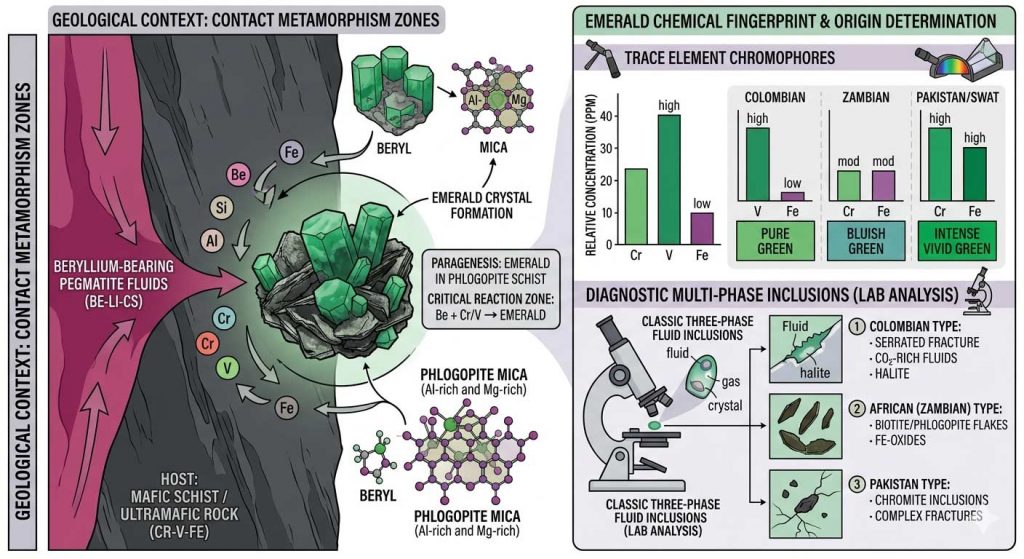
These localities are celebrated for rich, commercially viable gem-bearing zones characterized by a specific geological paragenesis: idiomorphic emerald crystals developed within a phlogopite schist matrix formed at the contact zones of pegmatitic intrusions.
Regional Phenotypes and Origin Determination
In trade jargon, a gemstone’s visual phenotype is frequently linked to its geographic origin. Historically, diagnostic color profiles have guided market perception:
- Colombian Emeralds: Celebrated for their warm, intense, and pure vivid green hues.
- Zambian Emeralds: Characterized by a cooler, slightly bluish-green secondary undertone.
Despite these classic trade generalizations, a high degree of overlap exists between the visual characteristics of different localities. Consequently, elite gemological laboratories do not rely solely on visual aesthetics; instead, they utilize advanced spectrometry and micro-analysis of diagnostic internal features to definitively determine geographic origin.
Clarity Profiles, Inclusions, and Structural Integrity
In the international wholesale sector and on major trading bourses, eye-clean emeralds are exceptionally rare anomalies. The vast majority of commercial and high-end investment-grade emeralds feature a complex network of internal characteristics traditionally referred to as “jardin” (garden) or inclusions.
           ┌───────────────────────────────────────────────┐
           │     THE EMERALD VALUE DETERMINATION SCALE     │
           └───────────────────────────────────────────────┘
  [Higher Inclusion Density]                       [Minimal Inclusions / "Jardin"]
  ◄─────────────────────────────────────────────────────────────────────────────►
  Decreased Clarity & Stability                     Premium Pricing & High Value
As an absolute rule of gem valuation, the less visible these internal characteristics are to the naked eye, the higher the stone’s premium and per-carat price.
Mechanical Vulnerability and Material Risk
While emerald possesses a high Mohs hardness ($7.5 – 8$), making it highly resistant to surface scratching and abrasive wear, its toughness (resistance to breakage) is inherently compromised. The crystal structure is typically subject to significant internal strain, sub-surface fractures, and macroscopic fissures.
Risk Mitigation Note: Because of these inherent molecular fissures and structural cleavages, emeralds are highly susceptible to fracturing under mechanical shock or directional pressure.
Mastery in Lapidary Arts and Jewelry Setting
The structural delicacy of emeralds demands elite mastery from master lapidaries (cutters) and skilled master-setters (bench jewelers).
During the fashioning stage and subsequent setting (micro-pave, claw, or bezel mounting), artisans must apply highly specialized, low-pressure techniques to prevent catastrophic structural failure or cleavage propagation. It is this exact combination of the gem’s hypnotic, signature green hue and the demanding, high-risk expertise required to bring it to market that cements its status as a uniquely premium asset among colored stones.
Standard Commercial Faceting and Silhouette Formats
To maximize weight retention from the rough crystal matrix while optimizing light return and color saturation, lapidaries utilize a diverse taxonomy of traditional and fancy cuts:
Classic and Geometric Silhouettes
- Emerald Cut: The classic stepped rectangular or square cut with truncated corners, engineered specifically to mitigate mechanical stress during setting.
- Cushion & Radiant: Modified brilliant/step hybrids that maximize brilliance and saturation.
- Asscher & Princess: Sharp-cornered geometric silhouettes used primarily in contemporary high jewelry.
- Baguette & Tapered Baguette: Linear step-cuts utilized frequently as accent side stones.
Organic and Fancy Profiles
- Pear, Heart, & Oval: Curvilinear silhouettes that maximize face-up size and yield from elongated rough.
- Marquise: An elongated, eye-shaped double-pointed cut that enhances color depth.
- Round Brilliant: A highly refractive faceting style used predominantly for smaller accent goods (melee).
- Trillion & Drop: Triangular and pendulous variations designed for unique geometric symmetry.
Non-Faceted Cuts
- Cabochon: A smooth, domed polish with a flat base, typically reserved for highly included, opaque, or deeply saturated material to showcase rich color and mask internal structural flaws.
Beyond these standardized commercial profiles, master cutters frequently execute bespoke fancy cuts tailored explicitly to the unique anatomy, dimensions, and structural constraints of the raw host crystal.

Copyright © 2026. All Rights Reserved.
All intellectual, academic, and proprietary rights concerning this article are strictly reserved by the author, Mr. Mohammad Mossadegh. Any unauthorized reproduction, distribution, plagiarism, or duplication of this material, in whole or in part, without the prior express written consent of the author is strictly prohibited and constitutes a violation of international copyright laws.
Author Contact Information:
Email: Mohammad@MossadeghGems.com